
Technical Debt in an MVP: Good Shortcuts, Bad Shortcuts and How to Track Them
 Muhammad UbaidullahFounder & Lead Engineer, Malvora
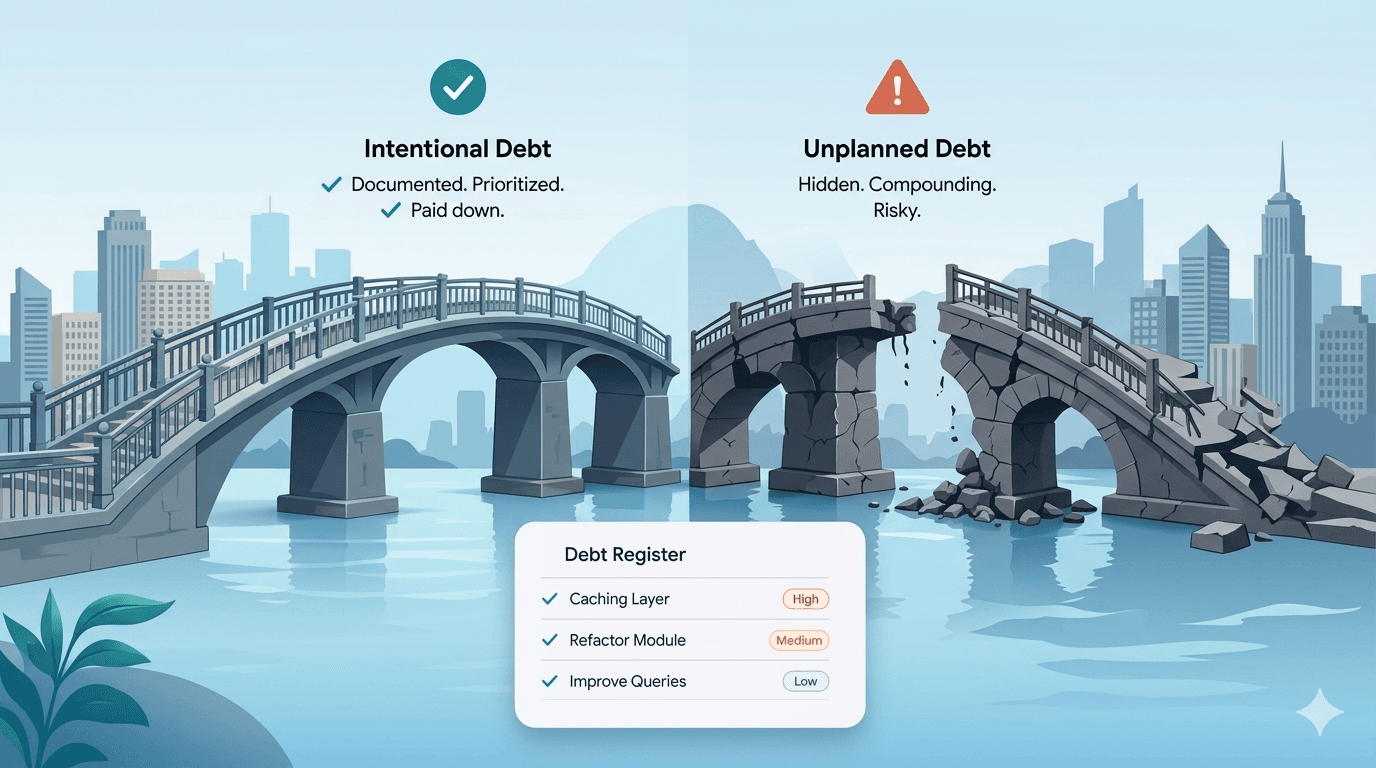
Technical debt isn't bad. Unplanned debt is. Learn which MVP shortcuts are safe, which to never take, and how a debt register keeps risk visible.
Technical debt has a bad reputation, but it isn't the enemy of an early-stage startup. Unplanned technical debt is. Taking deliberate shortcuts to launch faster is a legitimate strategy for an MVP, as long as you know exactly which shortcuts you took, why, and when you'll pay them back. This guide explains the difference between good and bad technical debt, the shortcuts you should never take, and a simple tool (a debt register) that turns hidden risk into a plan.
What technical debt actually is
Technical debt is the future cost of a shortcut you take today. You skip something to ship sooner, and later you pay it back with extra work, usually with interest.
That's the same way a business uses a loan. Borrowing to buy equipment that earns money is smart. Borrowing without knowing the interest rate, or forgetting you borrowed at all, is how businesses get into trouble. Software works the same way. The problem is rarely the debt itself. It's debt nobody wrote down.
For a founder, this matters because technical debt is mostly invisible. You won't see it in the product demo. You'll see it six months later, when a feature that should take a week takes six, or when a change in one place keeps breaking something somewhere else.
Good debt vs bad debt
The easiest way to tell them apart: good debt is reversible and contained. Bad debt is load-bearing, meaning other things get built on top of it.
Good debt: you skip a caching layer to launch faster, with a documented plan to add it when pages start to slow down. If you never need it, you saved the time. If you do, adding it later is a contained piece of work.
Bad debt: you design a database schema that can't support multiple organisations because nobody thought about team accounts. Every feature you build afterwards assumes that shape. When your first enterprise customer asks for teams, you're facing a rewrite instead of a feature.
The rule: document every shortcut you take. If you can't write down why you did it and when you'll fix it, don't do it.
Shortcuts that are usually fine in an MVP
These are shortcuts that save real time early and are cheap to fix later.
Doing admin tasks manually. Approving accounts, issuing refunds or sending reports by hand for your first users instead of building admin screens.
Skipping performance optimisation. No caching, no background job queues, no fine-tuned queries until real usage shows where it's slow.
Simple, single-region hosting. One server or one managed platform, not a multi-region setup built for traffic you don't have yet.
Basic internal tools. A spreadsheet or a no-code dashboard for internal reporting, instead of a custom analytics system.
Hardcoded content and settings. Copy, plans or limits written into the code instead of an editable settings system, as long as they're kept in one place.
Shortcuts you should never take
Some shortcuts look cheap and turn out to be the most expensive decisions in the company. Avoid these even in an MVP.
Security basics. Skipping password hashing, access checks, input validation or secure handling of secrets. A breach can end an early-stage company.
The data model. Ignoring who owns each record, how accounts relate to organisations, or how money is stored. These shape everything built afterwards.
Backups. If your data isn't backed up and you've never tested a restore, you don't have backups.
Money correctness. Anything that calculates, charges or pays out money should be correct and traceable from day one, even if the process around it is manual.
No tests at all on critical paths. You don't need full test coverage, but sign-up, login and payment flows should have automated checks.
A real example of a deliberate shortcut
On a courses-and-referral platform our team built, the client couldn't get approved by Stripe and had no local payment gateway available. Rather than delay launch while waiting for a payments integration that wasn't possible, we built manual pay-ins, where users submitted a transaction ID or screenshot that admins verified, and handled payouts through bank APIs.
That's what good technical debt looks like. The shortcut was the process (people verifying payments by hand), not the correctness of the money. Every transaction was still recorded and traceable, and the manual step could be replaced later without rebuilding the rest of the platform.
The debt register: how to keep debt under control
Ask your engineers to maintain a debt register. It's not a guilt list. It's a prioritised backlog of known shortcuts with their business impact, and it turns invisible risk into manageable work.
Each entry needs five things.
The shortcut. What was skipped or simplified, in one plain sentence.
Why we took it. Usually "to launch by a specific date" or "we don't know yet if we need it."
The trigger. The signal that means it's time to fix it, such as "page load over two seconds" or "first customer asking for team accounts."
The business impact. What happens if we don't fix it when the trigger hits: slower sales, support load, risk to data.
The owner. Who is responsible for watching the trigger.
A shared document or a label in your task tracker is enough. The tool doesn't matter. What matters is that debt has a name, an owner and a trigger.
When to pay technical debt back
Don't schedule debt payments on a calendar. Pay them back when the trigger hits, or when the debt starts slowing down work you need to do anyway.
Good moments to pay down debt: when you're about to build a feature on top of a shortcut, when the same part of the code keeps causing bugs, when a customer or sales opportunity depends on it, or right after launch, when you've learned which parts of the product actually matter. Many teams set aside a fixed share of each development cycle for this, so it never builds up into a crisis.
How founders should talk to engineers about debt
If you're a non-technical founder, you don't need to understand every shortcut. You need to ask the right questions. At the end of each milestone, ask: what shortcuts did we take, what would make us fix them, and which ones would be expensive to fix later? If the answer is "none," be curious, not relieved. Every fast-moving team takes shortcuts. The healthy ones can tell you exactly where they are.
How we handle technical debt at Malvora
On every build, we keep shortcuts visible. We decide them with the founder, write them down with a trigger, and refuse the ones that touch security, data ownership or money correctness. That way you launch fast and know exactly what the next round of work looks like. And because you own the code, the register goes with it.
Frequently asked questions
Is technical debt always bad?
No. Deliberate, documented debt is a normal and useful trade-off in an early-stage product. Debt becomes a problem when nobody knows it exists, when it touches foundations like the data model, or when it's never paid back.
How much technical debt is acceptable in an MVP?
As much as you can list, explain and reverse. If a shortcut is contained and has a clear trigger for fixing it, it's usually fine. If it would force a rewrite to undo, it's too much.
How do I know if my product has too much technical debt?
Common signs are features taking much longer than estimated, the same bugs coming back, engineers avoiding certain parts of the code, and small changes breaking unrelated things.
Should we rewrite our product to get rid of technical debt?
Rarely all at once. Most teams get better results by fixing the specific areas that block growth, one at a time, while the product keeps running.
Worried about the shortcuts in your current product, or planning a build and want to take the right ones? Book a Free Call. We'll help you separate the debt that's fine from the debt that will cost you.
Every insight here comes from real projects. If something resonates with a challenge you’re facing, tell us about it on a free 30-minute call, whether you run a business or are building a product.
Want this applied to your project?
Running a business or building a product? Book a free 30-minute call. Fixed quote after.
More insights