
Startup System Design: 3 Architecture Decisions That Break at Scale
 Muhammad UbaidullahFounder & Lead Engineer, Malvora
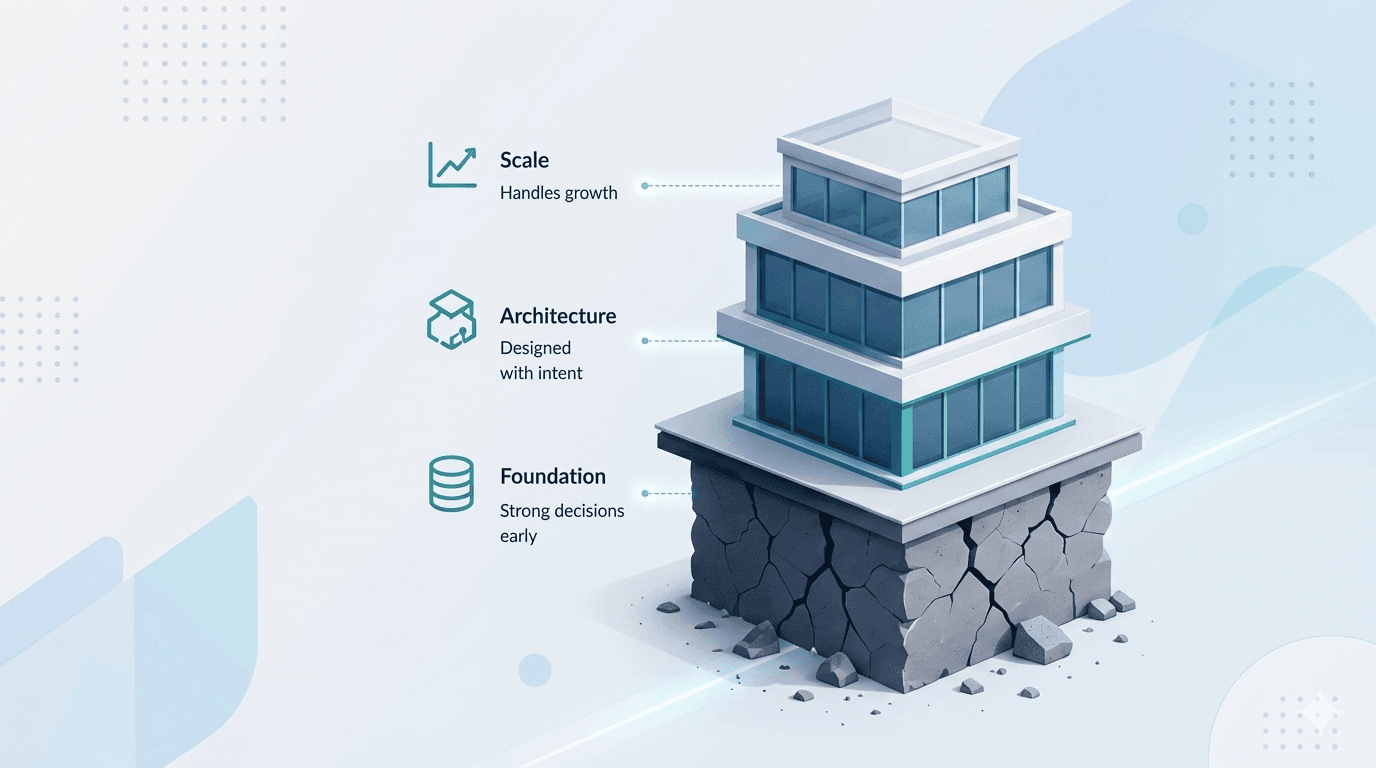
Your data model, service boundaries and auth decide whether your startup scales. What founders should get right before writing a line of code.
Most early-stage startups don't die from bad marketing or the wrong pricing. A surprising number get stuck because their architecture can't survive their own success, and fixing it mid-traction is slow, risky and expensive. This guide is for founders, technical or not, who want to get the three hardest-to-change system design decisions right before the first line of code: the data model, service boundaries, and authentication.
By the time you have real user volume, the wrong decisions are already load-bearing. Other features depend on them. Customer data lives inside them. You can't swap them out without slowing down the whole business. So it pays to know which decisions matter early, and which ones can safely wait.
Why early architecture decisions are so expensive to change
Most technical choices in a startup are cheap to reverse. You can swap a UI library, rewrite a page, or change hosting providers in days. A few choices are different. They shape how every other part of the system is built, so changing them later means touching almost everything.
Think of it like a house. You can repaint rooms, change the kitchen and replace the windows whenever you like. Moving the foundation is a different job entirely. In software, the foundation is your data model, how your system is split into parts, and how users, accounts and permissions work.
The good news: getting these right doesn't require a huge upfront investment. It requires an afternoon of the right thinking before you build.
Decision 1: Your data model
Your database schema is the most consequential thing you'll design in week one. It touches everything: how fast your queries run, how hard new features are to build, and how painful every future migration becomes.
The most common mistake is designing for correctness in theory rather than for how the product will actually read and write data. Over-normalising data that is always read together creates joins that hurt at scale. Under-modelling relationships that later become core features forces painful backfills, where you rewrite millions of existing records to fit a new shape.
Design for the 10x version of your business, not just where you are today. In practice, that means asking a handful of concrete questions.
What data will we almost always read together? That shapes how you group tables and what you index.
Which reports will the business need every week? If finance needs revenue by customer by month, make sure the data to answer it is captured from day one.
Who owns each record? In a B2B product, almost every table should know which organisation it belongs to. Adding that later is one of the most painful migrations there is.
What will we need to filter and sort by at volume? Those fields need indexes, and some need to be designed in up front.
A few defaults save a lot of pain: store money as integers in the smallest currency unit, keep created and updated timestamps on every table, prefer soft deletes for anything a customer might want back, and keep an audit trail for sensitive changes.
The schema you ship in your MVP is the one you'll be migrating around later. Treat it as a foundation, not a draft.
Decision 2: Service boundaries (why microservices at launch is usually wrong)
This one is misunderstood by founders who've read too many big-tech engineering blogs. Microservices, where your system is split into many small independently deployed services, are mostly a solution to an organisational problem: lots of teams needing to ship independently. They are rarely the right starting point for a team of three to ten engineers.
A well-structured monolith with clean internal module boundaries is faster to build, easier to debug, much cheaper to run, and straightforward to split up later once you have a team large enough to justify it. Teams that start with microservices often spend their first months wiring services together, managing deployments and chasing bugs across network calls, instead of shipping product.
The better call for most startups is a modular monolith: one application, organised into clearly separated domains (billing, users, content, notifications) that talk to each other through defined interfaces rather than reaching into each other's data.
Extract a separate service only when one part of the system has genuinely different needs. Common examples are a file or video processing pipeline that needs different hardware, a notification system that sends large volumes on its own schedule, or a component a separate team now owns. That decision usually belongs after product-market fit, not before launch.
Decision 3: Authentication and permissions
Auth is where startups hurt themselves most quietly. A basic email-and-password setup that works for 1,000 users becomes a serious problem when an enterprise client asks for single sign-on (SSO), when you need team accounts with multiple users, or when different users need different levels of access.
The answer isn't to over-engineer from day one. It's to choose a foundation with room to grow.
Use a well-established auth provider rather than writing your own login, password reset and session handling. This is security-critical code, and good providers handle it better than a startup can in week one.
Model organisations separately from users. A user belongs to one or more organisations or workspaces. Billing, data ownership and settings attach to the organisation, not the individual.
Structure permissions around roles from the start, even if you only have "admin" and "member" today. Adding a third role later should be a configuration change, not a rewrite.
Never hardcode organisation-level logic into the user table. It works for a month and blocks you for a year.
If you're building a B2B product and your auth can't support organisations, workspaces or team invites without a rewrite, you've already put a ceiling on your enterprise sales.
The decisions that can safely wait
Just as important as getting the foundations right is not wasting time on things that don't matter yet. Most startups can safely postpone complex caching layers, container orchestration platforms like Kubernetes, multi-region deployments, event-streaming infrastructure, and custom internal tooling for operations. Each of these solves a problem you'll know you have when you have it. Until then, they cost engineering time and monthly bills without making the product better for users.
Questions to ask your engineering partner before you build
You don't need to be a systems architect. You need someone on your team who is, or access to one before the decisions get made. Ask your engineering partner these questions and listen carefully to the answers.
How does this hold up at 10x our current or expected load, and what breaks first?
How do we add team accounts, organisations or multi-tenancy later?
What does a database migration look like when a table has 5 million rows?
What would we change if an enterprise customer asked for SSO next quarter?
Which parts of this design are hard to change later, and why did we choose them?
If the answers are vague or defensive, that's an important signal. A good engineer will tell you clearly which decisions are foundations and which are paint.
How we approach architecture at Malvora
The startups we work with don't all get these decisions perfect. But they get them in front of the right thinking early, which is usually enough. Before any build, we walk through the data model, the module boundaries and the auth and permissions model with the founder, write the key decisions down, and flag the ones that are expensive to change. Then we build the simplest version that keeps those doors open.
Frequently asked questions
Should a startup use microservices or a monolith?
For almost every early-stage startup, a modular monolith. It's faster to build, cheaper to run and easier to debug. Split out separate services later, when one part of the system has clearly different scaling needs or a separate team owns it.
When should a startup think about scalability?
Think about it early for the decisions that are hard to change (data model, accounts and permissions, billing), and late for everything else. Don't build infrastructure for millions of users before you have hundreds.
Do I need a CTO before building my MVP?
You need senior architecture input before the foundational decisions are made. That can be a technical co-founder, a fractional CTO, or a senior engineering partner who will explain the trade-offs to you in plain language.
Is it worth rebuilding my product's architecture?
Sometimes, but rarely all at once. Most teams get better results by fixing the specific foundation that's blocking growth, such as the data model or permissions, while the rest of the product keeps running.
If you're pre-build or mid-build and not confident in your architecture decisions, Book a Free Call. We'll review what you're planning, flag the decisions that will hurt you at scale, and tell you what to do differently before it's expensive to change.
Every insight here comes from real projects. If something resonates with a challenge you’re facing, tell us about it on a free 30-minute call, whether you run a business or are building a product.
Want this applied to your project?
Running a business or building a product? Book a free 30-minute call. Fixed quote after.
More insights