
Missed Calls Are Costing Contractors Jobs: 5 Ways to Stop It
 Muhammad UbaidullahFounder & Lead Engineer, Malvora
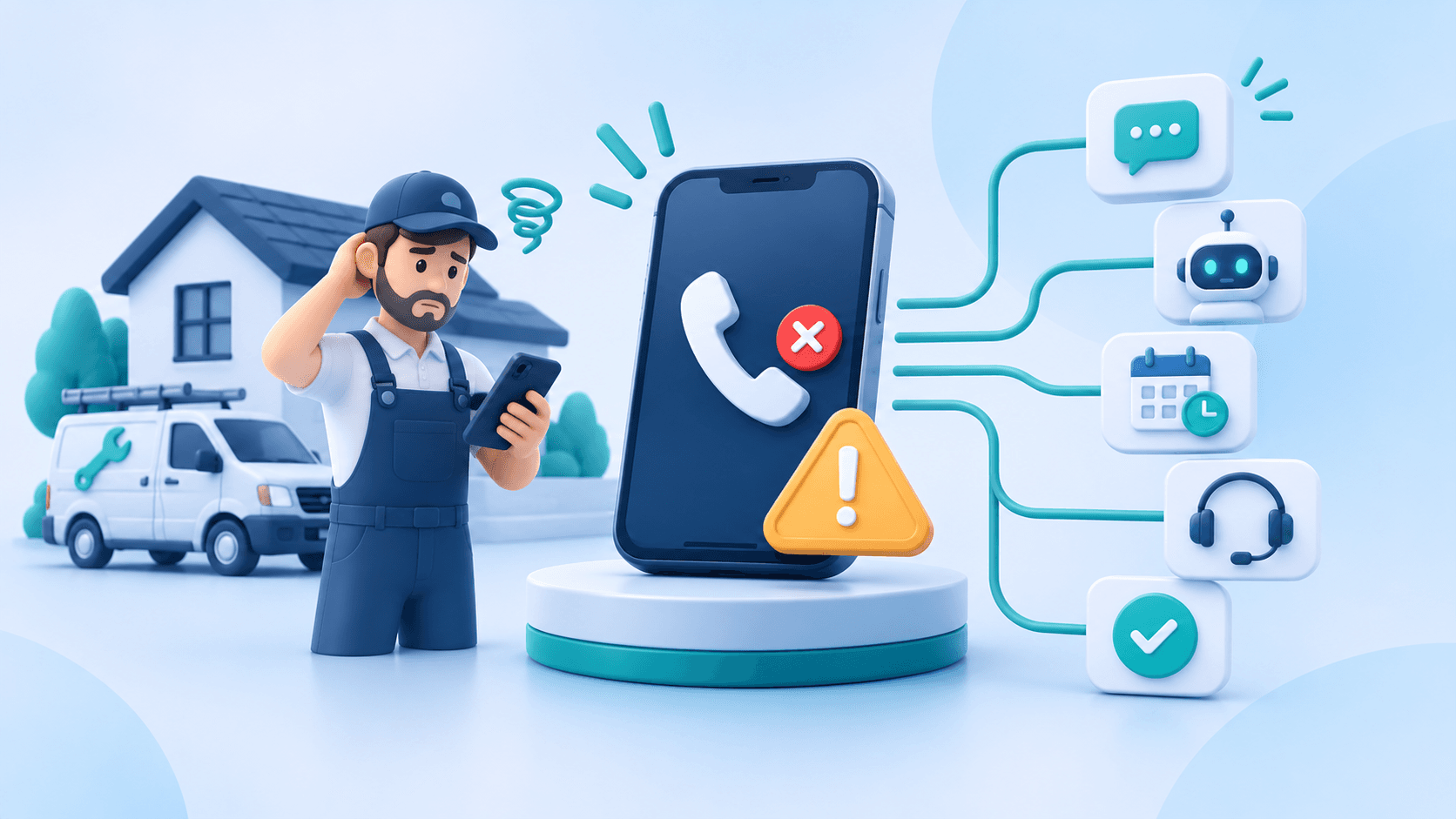
Every missed call can be a lost job. Compare 5 ways home services businesses can stop missing calls, from text-back to an AI receptionist.
Every home services business owner knows the feeling. You're on a roof, under a sink or halfway through a panel upgrade, and your phone rings. You can't answer. By the time you call back, the customer has booked someone else. This guide explains why missed calls cost contractors more than most owners realise, the five ways to stop losing those jobs (from free to fully automated), and how to choose the right one for the size of your business.
Why missed calls hurt contractors more than most businesses
When someone calls a restaurant and nobody answers, they might try again later. When someone has a leaking pipe, a dead furnace or a storm-damaged roof, they don't wait. They call the next company on Google.
Home services customers are often in a hurry, and they're usually calling several companies at once. In many cases, the job goes to whoever picks up first, or at least whoever responds first. That means a missed call isn't just a missed conversation. It's often a missed job, and sometimes a missed long-term customer who would have called you for years.
The tricky part is that missed calls are invisible. You see the jobs you win. You rarely see the ones that went to a competitor because you were busy doing the work.
Step one: find out how many calls you're actually missing
Before you buy anything, measure the problem. Most phone systems and business phone apps show missed calls. Look back over the last month and count how many calls went unanswered, how many of those numbers you called back, and how quickly. Then check how many of them turned into booked jobs.
Also look at when calls are missed. During jobs? At lunch? Evenings and weekends? The pattern tells you which fix makes sense.
Option 1: A proper voicemail and a fast call-back habit (free)
The simplest fix costs nothing. Record a short, clear voicemail that says who you are, that you're on a job, and when they'll hear back. Then commit to calling back within a set window, between jobs if possible.
This works for very small teams with modest call volume. The weakness is obvious: many customers won't leave a voicemail, and a call-back an hour later may already be too late.
Option 2: Automatic text-back for missed calls (low cost)
Many business phone services can send an automatic text message when a call goes unanswered. Something like: "Sorry we missed you, this is [business name]. We're on a job right now. What do you need help with? Reply here and we'll get back to you shortly."
This keeps the conversation alive. Customers who wouldn't leave a voicemail will often reply to a text, and you can respond between tasks. It's one of the best value fixes available for a small contractor.
Option 3: An answering service (people answer for you)
A human answering service picks up when you can't, takes the customer's details and passes them to you. Some can book appointments into your calendar.
The upside is a real person on the line. The downsides are cost, which usually rises with call volume, and the fact that operators don't know your business deeply, so they can usually only take a message rather than answer real questions about your services.
Option 4: An office person or dispatcher
As a business grows, hiring someone to answer phones, book jobs and manage the schedule often pays for itself. They know your business, can answer most questions, and can handle quoting and follow-ups too.
It's the most capable option and the most expensive. It also has limits: one person can only take one call at a time, and they go home in the evening.
Option 5: An AI phone or chat assistant
An AI assistant can answer calls or website chats at any hour, in a natural voice or text, using information about your business. A well-set-up assistant can answer common questions (service areas, what you do and don't do, how estimates work), collect the customer's name, address and problem, book an estimate into your calendar or flag an emergency, and send you a summary straight away.
Picture a heating company at 11pm in January. A homeowner calls because the furnace stopped. Instead of voicemail, the assistant confirms the address is in the service area, asks a few questions about the problem, explains the emergency call-out process, and books a first-thing-in-the-morning slot or alerts the on-call tech, depending on the rules the owner set.
AI assistants work best with clear rules and a human backup. They should know when to hand over to a person, never make promises you haven't approved (like exact prices for complex jobs), and send every conversation to you so nothing gets lost.
The goal isn't to replace you on the phone. It's to make sure no customer reaches a dead end while you're doing the work.
How to choose the right option
If you're a solo operator with a handful of calls a day, start with a clear voicemail and automatic text-back.
If you miss calls mostly after hours or during busy seasons, an AI assistant or answering service covers those gaps without hiring.
If you have several crews and the phones ring constantly, an office person plus an after-hours AI assistant is a strong combination.
Whatever you choose, the measure of success is simple: fewer missed calls, faster responses and more booked jobs.
What to ask before you buy an answering solution
Can it work with my existing phone number?
What happens when it can't answer a question? How does it hand over to me?
Can it book into the calendar or job software I already use?
How will I see every call or conversation it handles?
What does it cost as my call volume grows?
How is my customers' information stored and protected?
How Malvora helps contractors stop missing calls
We start by looking at when and why you miss calls, then set up the lightest fix that solves it. Sometimes that's just a missed-call text-back. For businesses that need more, we build an AI assistant trained on your services, service area and booking rules, connected to your calendar, with clear hand-over rules and a summary of every conversation sent to you. Fixed scope, fixed price.
Frequently asked questions
Will customers be annoyed by an AI assistant?
Most customers care about getting a fast, useful answer. Problems usually come from assistants that pretend to be human, go in circles or can't hand over to a person. Be upfront that it's an assistant, keep it focused and make it easy to reach a human.
Can an AI assistant give quotes?
It can share starting prices or price ranges you approve, and explain what affects the final price. For most jobs, it's better for the assistant to book an estimate and let you give the actual quote.
Is an AI receptionist better than an answering service?
It depends on your needs. AI assistants are available at any hour, can answer more detailed questions about your business and can book directly. Human services offer a real person. Some businesses use both.
Do I need new phone numbers or new software?
Usually not. Most solutions can forward unanswered calls from your existing number and connect to common calendar and job management tools.
Losing jobs to missed calls? Book a Free Call. We'll look at where your calls are slipping through and recommend the simplest fix.
Every insight here comes from real projects. If something resonates with a challenge you’re facing, tell us about it on a free 30-minute call, whether you run a business or are building a product.
Want this applied to your project?
Running a business or building a product? Book a free 30-minute call. Fixed quote after.
More insights