
Web App or Mobile App for Your MVP? A 3-Question Framework to Decide
 Muhammad UbaidullahFounder & Lead Engineer, Malvora
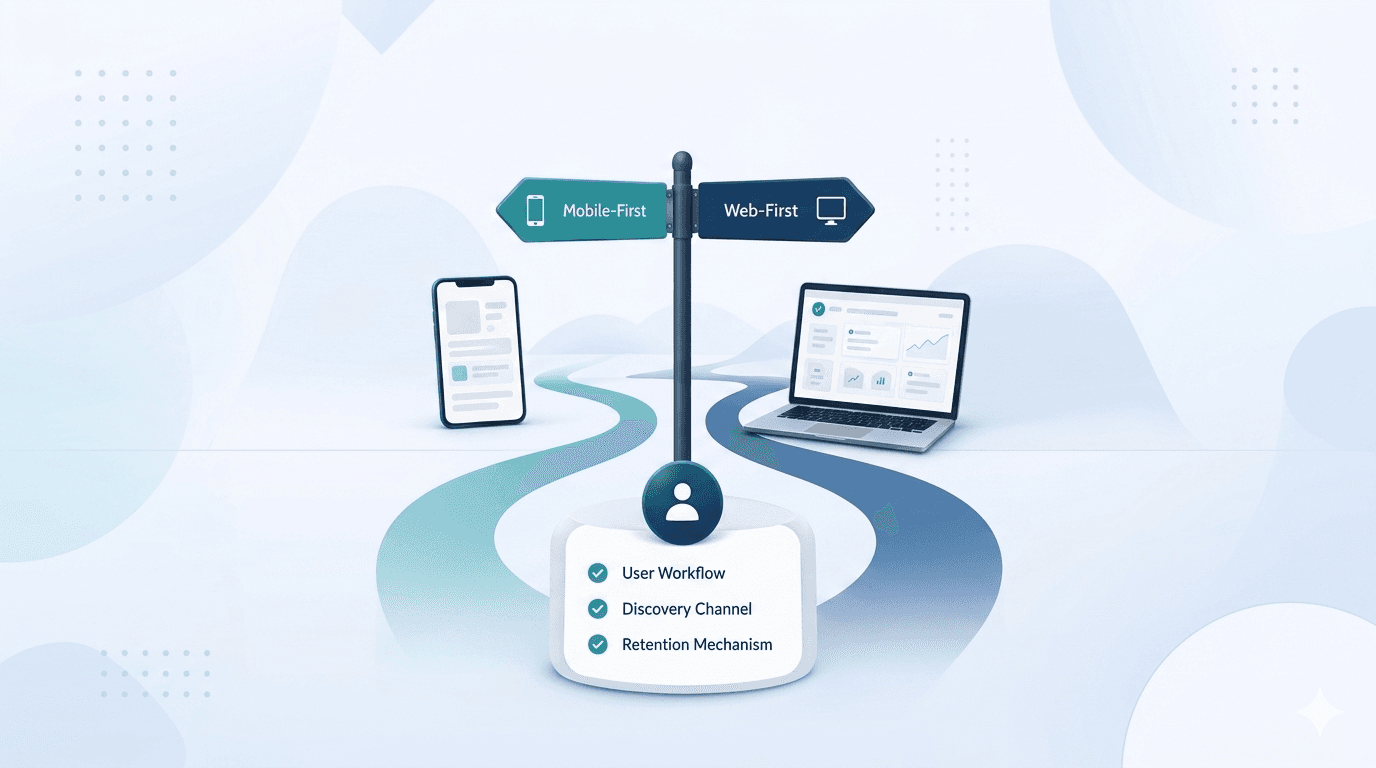
Should your MVP be a web app or a mobile app? Use this 3-question framework, the hidden costs of mobile and the middle-ground options to decide.
Should your MVP be a web app or a mobile app? Most founders default to web, and often that's right. But sometimes it's an expensive mistake, and the opposite default is too. The platform you choose affects your build cost, your timeline, how users find you and whether they come back. This guide gives you a simple three-question framework to decide, the hidden costs of each option, and the middle-ground choices that many founders overlook.
Why the platform decision matters so much
One of the most costly mistakes I see early-stage teams make is building on the wrong surface. Not the wrong technology, the wrong place for the user. Web vs mobile is a fundamental decision that affects almost everything after it.
A web app runs in a browser. You can update it any time, share it with a link, and reach users on any device. A native mobile app lives on the user's phone. It can send push notifications, use the camera and location more deeply, and sit on the home screen where the user sees it every day. But it has to be approved by app stores, installed by users, and in many cases built for both iPhone and Android.
Choose wrong and you either pay for capabilities you don't need, or you build a product that can't do the one thing your users need it to do.
The three-question framework
Ask these three questions about your product, in this order.
1. Where does your user complete the core workflow?
Picture the exact moment your user gets value from the product. Are they at a desk with a big screen, or out in the world with a phone in their hand?
A tool for reviewing contracts, analysing data or managing a team's projects is used at a desk. A product for checking in at a gym, tracking a run, scanning a receipt or finding a nearby service is used on the move. Build where the core workflow happens.
2. Where does your user discover similar products today?
How do your target users find tools like yours? B2B buyers usually search Google, read comparisons and sign up on a website, often with a sales conversation. Consumers often find apps through app store search, social media and friends, then install them directly.
If your growth plan depends on search and sales, a web product is easier to find and trial. If it depends on app store discovery and social sharing, mobile may be the natural home.
3. What brings your user back?
Retention is where the decision often gets made. Some products need to interrupt the user: a reminder to take medication, an alert that a delivery is nearby, a nudge to log today's habit. Those need push notifications and a home-screen presence, which mobile does best.
Other products are pulled by the user when they need them: a dashboard they check every morning, a tool they open to do a task. Email and browser bookmarks bring users back to those well enough.
If the answers point to mobile (used on the move, location-based, habit-forming, notification-driven), go mobile-first. If they point to the desk (data-heavy, workflow tools, B2B), go web-first.
Signs your MVP should be mobile-first
The core action happens away from a desk. The product depends on location, the camera or sensors. Users need timely notifications to come back. Usage is frequent and short, several times a day for a minute or two. Your audience mostly lives on their phones and discovers products through app stores and social media.
Signs your MVP should be web-first
The core action involves lots of data, typing or comparing information. Buyers are businesses that search, evaluate and sign up through a website. You need to iterate quickly and ship changes daily without waiting on app store review. Multiple people in a team need access from their work computers. You want users to try the product from a link with no install.
The middle ground most founders overlook
It's not always a strict choice between a website and two native apps.
A mobile-friendly (responsive) web app works well on phones and desktops from a single build. For many MVPs, this is enough to test the hypothesis before committing to native apps.
A progressive web app (PWA) is a web app that can be added to the home screen and work partly offline. Support for features like push notifications varies by device, so check it against your must-haves before relying on it.
Cross-platform frameworks such as React Native and Flutter let one team build for both iPhone and Android from a largely shared codebase. That usually costs much less than building two separate native apps, and it's the default choice for most mobile MVPs today.
The hidden costs of going mobile
Mobile apps can be exactly the right call, but founders should budget for costs that don't exist on the web.
App store review. Every release has to be approved, which adds days to your feedback loop and occasionally means rejections to fix.
Users on old versions. You can't force everyone to update instantly, so your backend has to support older versions of the app for a while.
Multiple apps, not one. Many products need more than one app. A food delivery platform our team built needed separate customer, seller and rider apps, and the hardest part of the project was keeping all three in sync as orders moved between them. If your product has multiple types of user, plan for that from day one.
Offline behaviour. Phones lose signal. If your app must work offline, that's a major design decision. On an offline-first couples journal app we built, the hardest problems were letting both partners edit while offline, uploading photos taken offline, and updating stored data safely when the app changed. Offline is achievable, but it should be a deliberate choice, not an afterthought.
A quick decision checklist
Before you commit, write down your answers to these.
Where exactly does the user get value: at a desk or on the move?
Does the product need push notifications, location, camera or offline use to work at all?
How will your first 100 users find the product?
How often will users come back, and what brings them back?
How many types of user does the product serve, and does each need its own app?
How fast do you need to ship changes after launch?
If most answers point the same way, you have your platform. If they're split, start with a responsive web app and add a mobile app once you've proven the core workflow.
How we help founders decide at Malvora
We make this call with the founder in week one, not week six. We walk through the three questions, look at how the first users will be acquired, and list the device features the product truly needs. Then we recommend the lightest platform that can test the hypothesis, whether that's a responsive web app, a cross-platform mobile app, or both.
Frequently asked questions
Is it cheaper to build a web app or a mobile app?
A web app is usually cheaper and faster for an MVP because it's one build, needs no app store approval and can be updated instantly. Mobile becomes worth the extra cost when the product genuinely depends on phone features or habits.
Should I build for iPhone or Android first?
Look at where your target users are. In North America, iPhone has a large share of users, but that varies a lot by market and audience. With a cross-platform framework you can often launch on both with little extra cost.
Can I start with a web app and add a mobile app later?
Yes, and it's a common path. If your backend is built with a clean API, a mobile app can be added later without rebuilding the core of the product.
Do I need a native app to send notifications?
Native apps handle push notifications most reliably. Web push works on many devices, but support and user experience vary, so test it against your requirements before depending on it.
Not sure whether your MVP should live on the web, on phones, or both? Book a Free Call. We'll walk through the framework with your product and give you a clear recommendation.
Every insight here comes from real projects. If something resonates with a challenge you’re facing, tell us about it on a free 30-minute call, whether you run a business or are building a product.
Want this applied to your project?
Running a business or building a product? Book a free 30-minute call. Fixed quote after.
More insights