
SaaS Pricing Architecture: Build Your Billing Model In From Day One
 Muhammad UbaidullahFounder & Lead Engineer, Malvora
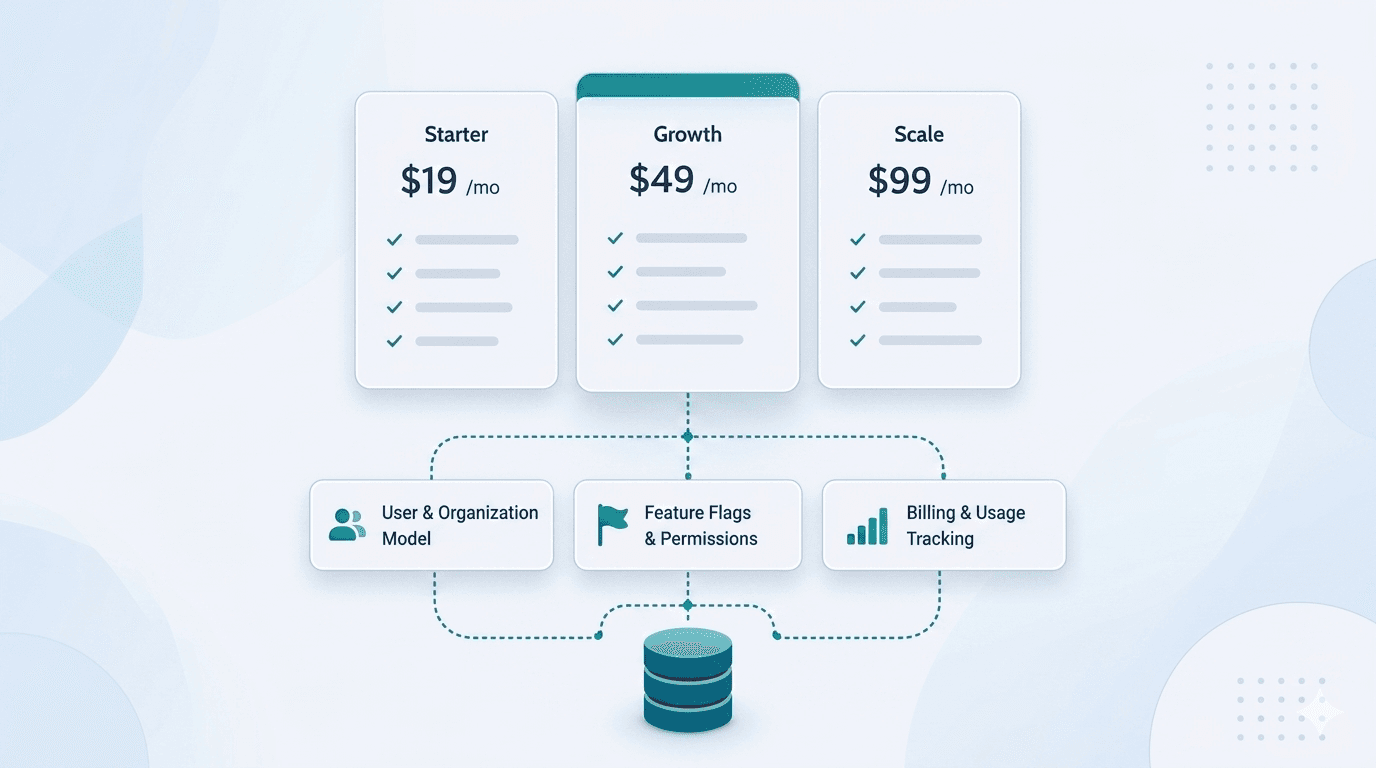
Per-seat, usage-based or tiered: your SaaS pricing model shapes your data model and billing. What to decide before your first sprint.
SaaS founders often treat pricing as a business decision and architecture as a technical one. They're the same decision. Whether you charge per seat, by usage or by feature tier has direct consequences for how your database, your billing integration and your feature access must be built. This guide explains what each pricing model requires under the hood, the billing mistakes that force painful rewrites, and a checklist to work through with your engineer before the first sprint.
Why pricing is an architecture decision
Retrofitting billing into an existing product is one of the most painful jobs in software. Pricing touches who can log in, which features each customer sees, what gets counted, what gets invoiced and what happens when a payment fails. If the product wasn't designed with those questions in mind, the answers end up scattered across the codebase as special cases.
The result is familiar to many founders: sales wants to test a new plan, and engineering says it will take a month. Not because the plan is complicated, but because the product was never built to change plans.
If you don't know your pricing model before you start building, you'll rewrite your user model twice.
Per-seat pricing: what it requires
Per-seat pricing charges for each user on an account. It's simple for customers to understand and common in B2B tools.
Under the hood, it needs a clean organisation and user data model. Customers are organisations (companies or workspaces), and users belong to them. The subscription attaches to the organisation, not to an individual.
It also needs role-based access (who is an admin, who is a member, who can invite people), a reliable count of active seats, and rules for what happens when someone is added or removed mid-billing period. Do you charge immediately, at renewal, or pro-rate? Decide early, because it affects both your billing provider setup and your product screens.
Usage-based pricing: what it requires
Usage-based pricing charges for what customers consume: API calls, messages sent, documents processed, minutes used. It aligns price with value, but it's the most demanding model to build.
It needs a metering layer from day one. Every billable action must be recorded as an event, with the customer, the quantity and the time. Those events must be counted exactly once, even when systems retry or fail, or customers will be over- or under-charged. They need to be totalled per billing period and sent to your billing provider, and customers need to see their usage in the product before the invoice arrives, so they're never surprised.
You'll also need limits and alerts: what happens when a customer hits their limit, and how they're warned before it. Adding all of this after launch means going back through every billable action in the product, which is exactly the kind of rewrite you want to avoid.
Feature-tiered pricing: what it requires
Feature-tiered pricing sells plans like Basic, Pro and Enterprise, each unlocking different features or limits.
It needs an entitlements system: a single place in the product that knows which features and limits each plan includes. The code should ask "does this customer have access to advanced reports?" rather than "is this customer on Pro?". That small difference means you can change what each plan includes, run a promotion or give one customer a custom deal without changing code.
We saw the value of this approach on a desktop point-of-sale product our team built and delivered to several retail shops. Instead of maintaining separate copies for each shop, we kept one shared product and customised branding and features per shop. The same thinking applies to SaaS plans: one product, with access controlled per customer.
Hybrid models
Many SaaS products end up combining models: a base subscription per seat plus usage charges, or tiered plans with usage limits. That's fine, as long as the foundations for each piece exist. If you think you may move to a hybrid model later, build the organisation model and the entitlements layer now, and record key usage events even if you don't bill for them yet. The data will also tell you what to charge for.
Choosing a billing provider (and what it won't do for you)
Providers like Stripe and Paddle handle the hard, regulated parts of billing: storing card details, charging customers, invoices, taxes in many regions, and retrying failed payments. For most startups, using one is the right call.
But a billing provider doesn't know your product. You still have to decide which plan unlocks which features, count usage, keep your product in sync with the subscription status, and handle failed payments, upgrades, downgrades and cancellations inside your app. Treat the billing provider as the source of truth for payments, and your entitlements system as the source of truth for access.
It's also worth checking availability early. Payment providers don't support every country or every type of business. On one platform our team built, the client couldn't get Stripe approval and had no local gateway, so we built manual payment verification and bank-based payouts instead. Knowing that before you design the checkout saves weeks.
Billing mistakes that force rewrites
Hardcoding plan names throughout the code instead of checking entitlements.
Attaching subscriptions to individual users when the customer is really a company.
Not recording usage events from the start, so there's no data to price on later.
Storing money as decimals with rounding errors instead of whole numbers in the smallest currency unit.
Letting product access and billing status drift apart, so customers who cancelled still have access, or paying customers get locked out.
Ignoring tax and currency until the first international customer arrives.
Pricing architecture checklist for your first sprint
Before your first sprint, work through these questions with your engineer.
How will we charge: per seat, by usage, by feature tier, or a mix?
Who is the customer, an individual or an organisation, and how do users relate to it?
Which features and limits does each plan include, and where will that be defined in the product?
Which actions could be billable, now or later, and are we recording them?
What happens on upgrade, downgrade, cancellation and failed payment?
Which billing provider will we use, and does it support our country, currencies and business type?
This one conversation can save weeks of refactoring down the line.
How we approach SaaS billing at Malvora
When we build a SaaS MVP, pricing is part of the first architecture conversation, not the last sprint. We agree the pricing model with the founder, design the organisation, entitlements and usage foundations around it, and connect a billing provider that fits the market. Even if you launch with one simple plan, the product is ready for the pricing you'll need next.
Frequently asked questions
When should I decide my SaaS pricing model?
Before you start building, at least at the level of per seat, usage or tiers. Exact prices can change later. The model shapes your data and access design, so it should be decided first.
Can I change my pricing model after launch?
Yes, if the product was built with an organisation model, an entitlements system and usage tracking. Without them, changing models often means significant rework.
Should I build my own billing system?
Almost never. Use an established billing provider for payments, invoices and taxes, and build only the product-specific parts: entitlements, usage tracking and in-app billing screens.
What's the easiest pricing model to build?
A simple flat or tiered subscription is the easiest to start with. Usage-based pricing is the most demanding because it needs accurate metering from day one.
Planning a SaaS product and not sure how your pricing should shape the build? Book a Free Call. We'll map your pricing model to the architecture you need, before it's expensive to change.
Every insight here comes from real projects. If something resonates with a challenge you’re facing, tell us about it on a free 30-minute call, whether you run a business or are building a product.
Want this applied to your project?
Running a business or building a product? Book a free 30-minute call. Fixed quote after.
More insights